Shot Kit: Commercial Photography Using 35mm Film
Reintroducing a fully manual film workflow as a way to slow down, stay present, and reconnect with the fundamentals of photography.
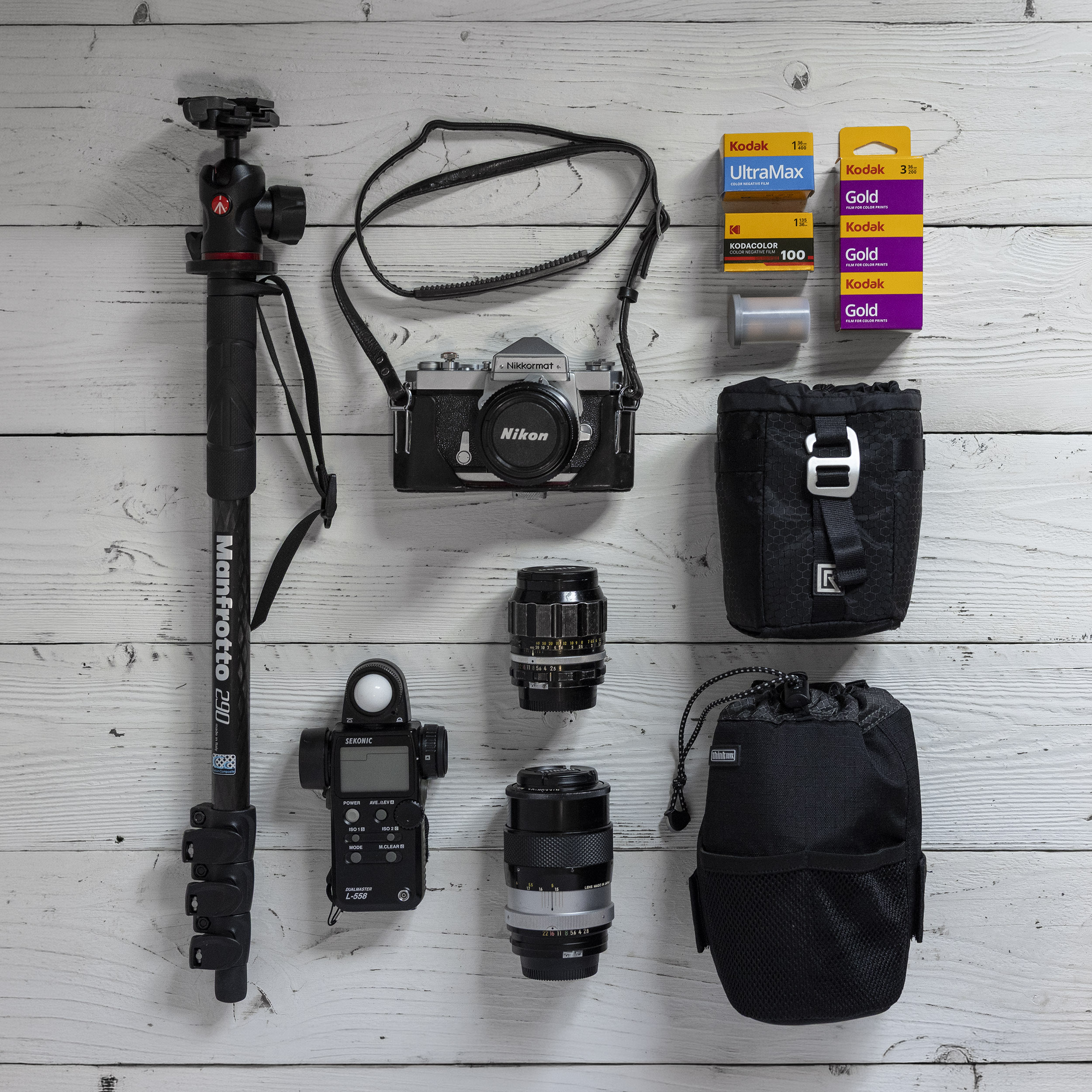
After more than two decades of shooting digitally, I’ve started carrying a film camera with me again. This small, fully mechanical kit has become a way to step away from speed and certainty, and focus more on timing, instinct, and the moment itself.
Returning to film has been less about nostalgia and more about recalibration. My professional work is built around precision, consistency, and control. Film pushes in the opposite direction. It removes the safety net and replaces it with experience and intent.
The last time film was part of my daily workflow was during my time at Brooks Institute of Photography. That’s where I learned to expose, develop, and print black-and-white film by hand. Those fundamentals never really leave you, but working digitally for years makes it easy to rely on instant feedback instead of instinct.
This camera brings that balance back. There’s no preview, no histogram, no corrections in the moment. You make a decision, commit to it, and move on. That shift alone changes how I see and respond to what’s in front of me.
Film doesn’t slow you down for the sake of it. It forces you to be more deliberate about what’s worth capturing.
The Camera
Nikkormat FTN
The Nikkormat FTN is a fully mechanical 35mm SLR introduced in the late 1960s. It was originally positioned as a more accessible alternative to Nikon’s professional F-series bodies, but it quickly earned a reputation for being just as capable and often more reliable due to its simpler construction.
This particular camera was gifted to me by my mentor, Thomas Hart Shelby, and has become the foundation of this kit. It’s heavy, solid, and entirely manual. No automation, no shortcuts. Just shutter speed, aperture, and a needle meter.
The experience of using it is part of the appeal. It feels like a tool, not a device.
Lenses
Micro-Nikkor 55mm f/3.5
This is the lens that stays on the camera most of the time. It’s sharp, compact, and sits in a very usable focal range. Long enough for portraits, wide enough for everyday scenes and small interiors.
It’s practical, predictable, and covers the majority of what I’m shooting with this setup.
Nikkor-P 105mm f/2.5
One of Nikon’s most iconic lenses. Known for its rendering and separation, this is my go-to for tighter portraits.
What I like most about this version is that it has a look that feels period appropriate. It’s less about technical perfection and more about character. It produces images that feel consistent with the era the camera comes from.
Nikkor-Q·C 135mm f/2.8
When I need more reach, this is the lens I bring in. It allows me to stay further back and capture moments without interrupting them.
It’s compact for its focal length and gives a bit more separation when I want it.
Support and Exposure
Sekonic Dualmaster L-558
Film doesn’t leave much room for error, and I don’t always rely on the internal meter. This gives me both ambient and spot readings so I can dial in exposure with confidence.
It’s a tool I’ve had for years, and it fits naturally back into the process.
Manfrotto 290 Carbon Monopod
When working with slower film stocks, stability matters. The monopod gives me just enough support without slowing me down or adding bulk.
It’s easy to carry and quick to deploy, which fits how I like to work with this kit.
Film Stocks
Kodak UltraMax 400
This is what I use when I want flexibility. It handles changing light well and gives me enough speed to work handheld without overthinking exposure.
It’s forgiving and practical, especially for street-style shooting.
Kodacolor 100
Slower, cleaner, and more deliberate. This is what I use when light is consistent and I want finer grain and a more controlled look.
It encourages a slower pace, which is part of the point.
Kodak Gold 200
Sits right in the middle. A good balance between flexibility and grain. If I’m not sure what I’ll run into, this is usually what I bring.
Carry System
BlackRapid Lens Drop
This stays on my belt with the 105mm inside. It allows for quick lens changes without going back to a bag.
It also holds an extra roll of film, which keeps everything within reach.
Think Tank Lens Drop
Used for the 135mm and additional film. It gives me enough room to carry what I need without overcomplicating the setup.
Keeping everything on my belt keeps the workflow simple and mobile.
Summary
This kit isn’t meant to replace the way I work professionally. It’s meant to balance it.
Film removes a layer of control and replaces it with trust. It forces decisions to be made in the moment, without the ability to immediately review or correct them. That shift changes how I approach a scene and what I choose to photograph.
At a time when photography is becoming increasingly automated and predictable, this process feels more grounded. It brings the focus back to observation, timing, and intent.
And that carries over, even when I go back to digital.